Saturday, 18 July 2009

Craft Fair at St James' Church, Welland

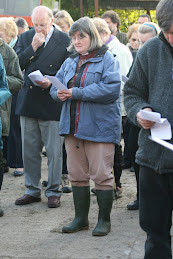
There are lots of Arts and Crafts on display at St James' Church, Welland this weekend.


Much of what is displayed is for sale, so it's a brilliant chance to do some early Christmas shopping.
All sorts of unusual hand-made crafts.

For full details of times, go to www.hanleyandwelland.org.uk


Sunday, 14 June 2009

A few more flower pictures


The theme is "Celebration" - this is a 4oth Wedding Anniversary


I get to take this lovely one home tonight - I won it in yesterday evening's raffle!


This is tiny! It's a detail in the arrangement celebrating Baptism.


An interesting character sitting in the church porch.


It's another beautiful day, and there's still time to come and join us! Both church and gardens are open until 5.00pm!

Jazz in the Garden


Perdido Street Jazz Band


Enjoying the picnic


Dancing in the twighlight

Saturday, 13 June 2009

Pictures from the Flower Festival


Here is just a taste of the many lovely arrangements that are at St Gabriel's Church, Hanley Swan this weekend (13th and 14th June).


As well as flower arrangements in church, a number of village gardens are open - and we have some very keen gardeners here! Lunches and teas are available, there's a jazz concert on Saturday evening and "Songs of Praise" service on Sunday. Full details are available on http://www.hanleyandwelland.org.uk/

The sun's shining here,
so come and join us if you're
within reach of Worcestershire!


Thursday, 11 June 2009

Flower and Garden Festival

At the moment I am praying fervently for good weather, as we have a major event at Hanley Swan this weekend. There is a Flower Festival at St Gabriel's Church, which also includes the opportunity to look round a number of local gardens. A very kind parishioner is serving lunches and teas in her garden on both Saturday and Sunday, as well as hosting a jazz event on Saturday evening. The weekend will be rounded off with a "Songs of Praise" service on Sunday evening. This event is in aid of the development fund, as we are hoping to be able to install a kitchen and loo in St Gabriel's Church, so that we can do things like running coffee mornings for older people.

If you live in the Malvern area, or you fancy a day out to beautiful South Worcestershire, all details of the event are on the our Benefice web-site www.hanleyandwelland.org.uk

Friday, 5 June 2009

Tissue donation for research into brain disease

Listening to an item on the Radio 4 Today Programme about research into Altzheimer's Disease and other illnesses that affect the brain, and the shortage of brain tissue available for research, I was reminded of what happened when my mother died in 2003.

Sadly, by the time she died, she was suffering from dementia, but some years before she had decided that she would like to leave her body for medical research. Neither of my parents had enjoyed good health in their lives, and I think that she saw it as a way of giving something back to the medical world that had treated them, and indeed probably saved my life as a baby too. My mother wrote to the Bristol University Medical School who agreed that, subject to all the usual caveats, they would like to have her body when she died. The letter was carefully placed with her will so that I would be able to arrange matters when the time came.

In the event, the medical school was unable to receive her bequest; they were not accepting the remains of anyone who had suffered from dementia because of fears about CJD. While I understand that this could potentially present dangers to those handling bodies, the thing that I find hard to understand was why they did not make any alternative suggestion. Surely a medical school must be aware of research being carried out in other places? If it had not been for a wonderfully helpful funeral director, I would just have accepted what they said and my mother's body would have been cremated.

Fortunately, the funeral director did not just take "no" for an answer. She remembered that some time previously she had been involved in facilitating the donation of a brain to King's College, London for reasearch specifically into dementia - a member of this research project was one of the people interviewed on the radio this morning. Time was of the essence, as my mother had died over a weekend so everything had to be completed on the Monday if the tissue was to be in a useable condition. In the space of a few hours, the funeral director got in touch with King's College, arranged for the necessary post mortem work to be done locally, had the consent forms faxed to her for my signature and faxed them back, and taken my mother to Worcester Royal Hospital. By mid-afternoon, my mother was brought back to the funeral parlour and we arranged for her funeral in the normal way.

What struck me then, and again listening to the radio this morning, was how lucky we were that we were able to fulfil my mother's wishes. It was sheer chance that the funeral director was aware of the research at King's College, and was generous enough to go to considerable trouble to follow the matter through. OK, if I had searched the internet I may have found that or another project, but at a time of bereavement one's first instinct is not usually to start typing things into a search engine - well mine isn't, anyway. And in any event, with literally only hours available to us, the chance of achieving a satisfactory outcome would have been remote.

As someone who conducts numerous funerals in the course of a year, I am as aware as anyone of the vast spectrum of attitudes that people have to the mortal remains of their loved ones. At one end of this spectrum people see a body as still very much part of the person they love, and cannot bear the thought of them being violated in any way. At the other end people feel that all that is important about their loved one is now somewhere else, or perhaps has ceased to exist, and that the body is merely the discarded container. Attitudes range between these two extremes, and have little to do with religious belief. I am always impressed by the sensitivity of funeral directors who have to do their job in a matter-of-fact way, yet show enormous care to the feelings of relatives and friends. I hope that I have not upset anyone's sensibilities in writing about this subject, and have tried to address it as delicately as possible - if not delicately enough, I apologise.

We have all heard stories about people who have been upset by members of the medical profession who do not respect the feelings of bereaved families, although hopefully these are the exceptions rather than the rule. However, I do find it really surprising that when one medical group is offered a tissue-donation which for any reason it cannot accept, there is not a readily available list of others who may be glad to receive it. Both my mother and my mother-in-law ended their days in a state of dementia, which everyone agrees is a tragic culmination of a long and productive life. I am pleased that I was able to fulfil my mother's wishes, perhaps in a way that was more useful even than she envisaged. But in the light of my experience, I was saddened to hear the researchers this morning talking about the desperate need for the material for their work to find the causes of dementia and other debilitating brain diseases.

Friday, 22 May 2009

Standing up for Twittering

At Lunchtime on Wednesday (20 May), I received a completely unexpected telephone call from the Radio 4 "PM" programme. The Roman Catholic Bishop of Paisley, the Rt Rev Philip Tartaglia, had issued a warning to Catholics in Scotland that Twitter could damage real human relationships, and PM were looking for a clergy-person to disagree with him. Somehow, through the wonders of Internet searching, they had found me, and they wanted to know whether I could take part in an on-air discussion on the subject.

Since I'm never one to turn down the chance of a good discussion I agreed, subject to clearing it with my Diocesan Communications Officer and, if she deemed necessary, my Bishop. In the event, the discussion was not with Bishop Tartaglia but with the well-known Roman Catholic journalist, Joanna Bogle. I found myself sitting in a little room at Radio Hereford & Worcester recording a conversation with Ms Bogle in London - somewhat ironically, since we both agreed on the value of face-to-face contact and body language, we could only hear and not see each other.

The main difficulty for me was that, in many ways, I agreed with Ms Bogle's emphasis on the need for personal contact, and I expect that most other "twitterers" would have done too. Of course there is no substitute for face-to-face contact, for sharing a cup of tea with someone, shaking their hand or giving them a hug - no-one knows that better than a parish priest, whether Anglican or Roman Catholic. Of course old friends are important and should not be displaced by new ones made over the Internet. But why can these two aspects of friendship not run side-by-side? A very dear friend of 15 years' standing introduced me to Twitter; he lives some distance away and we now have more frequent contact than we've had since the days when we attended the same church. It is still great to see him and his family, but distance means this cannot happen more than a few times a year at most. My friendship with him is not diminished by the fact that we now both have online friends who join in with our conversations. Of course it is important for children and young people to be careful about the people they are in touch with, and for parents to exercise proper control. But isn't this just as true in the "real" world?

Many of my online friends are people that I would like to meet face-to-face some time, but who knows whether it will ever possible, living all over the UK and beyond as they do? Some too are people who do not find it easy to get out, and to whom it is a boon to be able make contact with people via their computers. Strangely, the Bishop is quoted in the Telegraph as referring to making friendships with "real people", as if those of us who twitter are actually not real; my online friends are real people, but I would have been unlikely to meet them in any other way. It is amazing how much you can get to know about people by exchanging views in 140 character snatches - to be honest I wouldn't have believed it either until I tried it! It's certainly good discipline for thinking about how to say something concisely - perhaps my congregation will see the benefit in my sermons?!

Not surprisingly, the weirdest part of the whole experience was listening to the broadcast interview. I am used to the fact that our voices never sound quite the same played back to us as they sound when we speak - even if I play back a message I've left on our answering machine, I think "Is that really me?" However, I've had quite a bit of public speaking and media training through the years, and know that the main dangers are speaking too high or too fast, and if doing anything in public always make a very conscious effort not too. I was therefore more than surprised that I appeared to be gabbling in a rather high pitched voice. My husband who - poor man - has to listen to me all the time said that he thought I sounded as if I'd had a close encounter with a helium balloon! I wondered whether the tape might have been run slightly fast, but my co-interviewee seemed, if anything, to be talking in a slightly slower, deeper voice than I remembered. No doubt all part of the "unreality" of technology, whether the new phenomenon of Twitter or much older one of radio!

When my parents were children, radio technology was in its infancy, and the levels of communication that we have today were beyond imagining. When I was a child, there were two black and white TV channels that closed down with the National Anthem at 10.00pm. Whatever the future holds, I hope that I will always be able to use whatever technology is available to meet new people and broaden my outlook on life. I'm glad that there are others who feel the same! Happy twittering!